← Back to changelog Hassieb Pakzad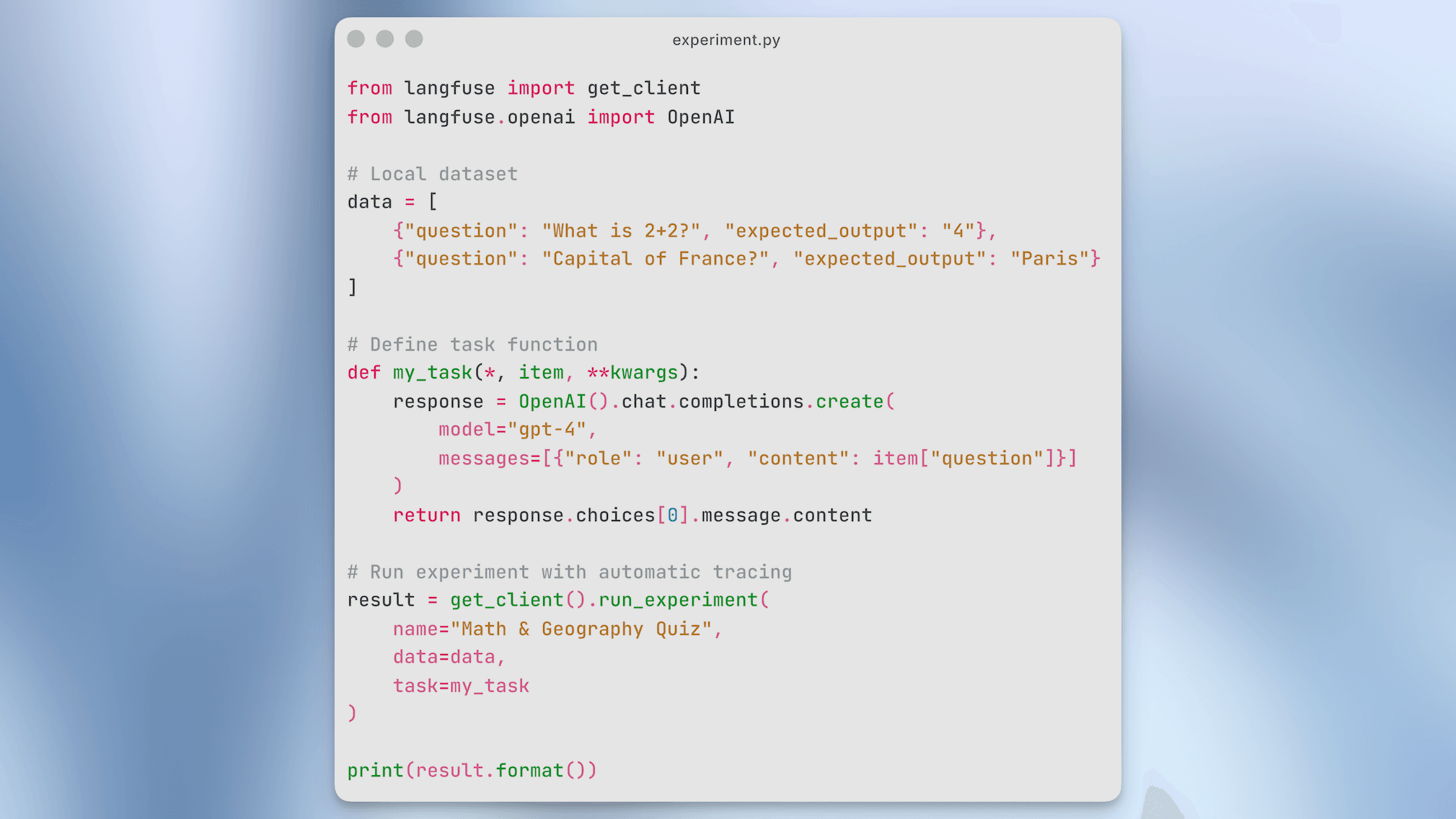
September 17, 2025
Experiment Runner SDK
Hassieb PakzadNew high-level SDK abstraction for running experiments on datasets with automatic tracing, concurrent execution, and flexible evaluation.
Both the Python and JS/TS SDKs now provide a high-level abstraction for running experiments on datasets. The dataset can be both local or hosted on Langfuse. Using the Experiment runner is the recommended way to run an experiment on a dataset with our SDK.
Key Features
The experiment runner automatically handles:
- Concurrent execution of tasks with configurable limits
- Automatic tracing of all executions for observability
- Flexible evaluation with both item-level and run-level evaluators
- Error isolation so individual failures don't stop the experiment
- Traces in Langfuse even though the core task function is not instrumented by automatic input / return value capture
- Dataset integration for easy comparison and tracking
Example
from langfuse import get_client
from langfuse.openai import OpenAI

# Initialize client
langfuse = get_client()

# Define your task function
def my_task(*, item, **kwargs):
    question = item["input"]

    response = OpenAI().chat.completions.create(
        model="gpt-4.1", messages=[{"role": "user", "content": question}]
    )

    return response.choices[0].message.content

# Run experiment on local data
local_data = [
    {"input": "What is the capital of France?"},
    {"input": "What is the capital of Germany?"},
]

result = langfuse.run_experiment(
    name="Geography Quiz",
    description="Testing basic functionality",
    data=local_data,
    task=my_task,
)

# Pretty print results
print(result.format())
This prints:
1. Item 1:
   Input:    What is the capital of France?
   Actual:   The capital of France is Paris.

   Trace ID: e52488cb13d426f55a2a7c178d4cb0d0

2. Item 2:
   Input:    What is the capital of Germany?
   Actual:   The capital of Germany is **Berlin**.

   Trace ID: 188cd8fc165446fa957a7c15423cbe0e

──────────────────────────────────────────────────
📊 Geography Quiz - Testing basic functionality
2 items
import { OpenAI } from "openai";
import { NodeSDK } from "@opentelemetry/sdk-node";
import {
LangfuseClient,
ExperimentTask,
ExperimentItem,
} from "@langfuse/client";
import { observeOpenAI } from "@langfuse/openai";
import { LangfuseSpanProcessor } from "@langfuse/otel";
// Initialize OpenTelemetry
const otelSdk = new NodeSDK({ spanProcessors: [new LangfuseSpanProcessor()] });
otelSdk.start();
// Initialize client
const langfuse = new LangfuseClient();
// Define your task function
const myTask: ExperimentTask = async (item) => {
const question = item.input;
const response = await observeOpenAI(new OpenAI()).chat.completions.create({
model: "gpt-4.1",
messages: [{ role: "user", content: question }],
});
return response.choices[0].message.content;
};
// Run experiment on local data
const localData: ExperimentItem[] = [
{ input: "What is the capital of France?" },
{ input: "What is the capital of Germany?" },
];
const result = await langfuse.experiment.run({
name: "Geography Quiz",
description: "Testing basic functionality",
data: localData,
task: myTask,
});
console.log(await result.format());
// Important: shut down OpenTelemetry to ensure traces are sent to Langfuse
await otelSdk.shutdown();This prints:
1. Item 1:
   Input:    What is the capital of France?
   Expected: null
   Actual:   The capital of France is **Paris**.

   Trace:
   https://cloud.langfuse.com/project/cloramnkj0002jz088vzn1ja4/traces/f8e12f19b4114621106512b923a1170f

2. Item 2:
   Input:    What is the capital of Germany?
   Expected: null
   Actual:   The capital of Germany is **Berlin**.

   Trace:
   https://cloud.langfuse.com/project/cloramnkj0002jz088vzn1ja4/traces/9852ca4665ceea9f83c2acfccf1b4052

──────────────────────────────────────────────────
📊 Geography Quiz - Testing basic functionality
2 items
Get Started
Learn more about the experiment runner incl. how to use it with Langfuse datasets, adding evaluators and more in our remote dataset runs documentation.
Was this page helpful?