Message Placeholders in Chat Prompts
Message Placeholders allow you to insert a list of chat messages ([{role: "...", content: "..."}]) at specific positions within a chat prompt.
You can define multiple placeholders in a prompt and resolve them with different values at runtime. Message Placeholders are also supported in the Playground and Prompt Experiments.
To use placeholders in your application, you need at least langfuse >= 3.1.0
(python) or langfuse >= 3.38.0 (js).
Create prompt with placeholders
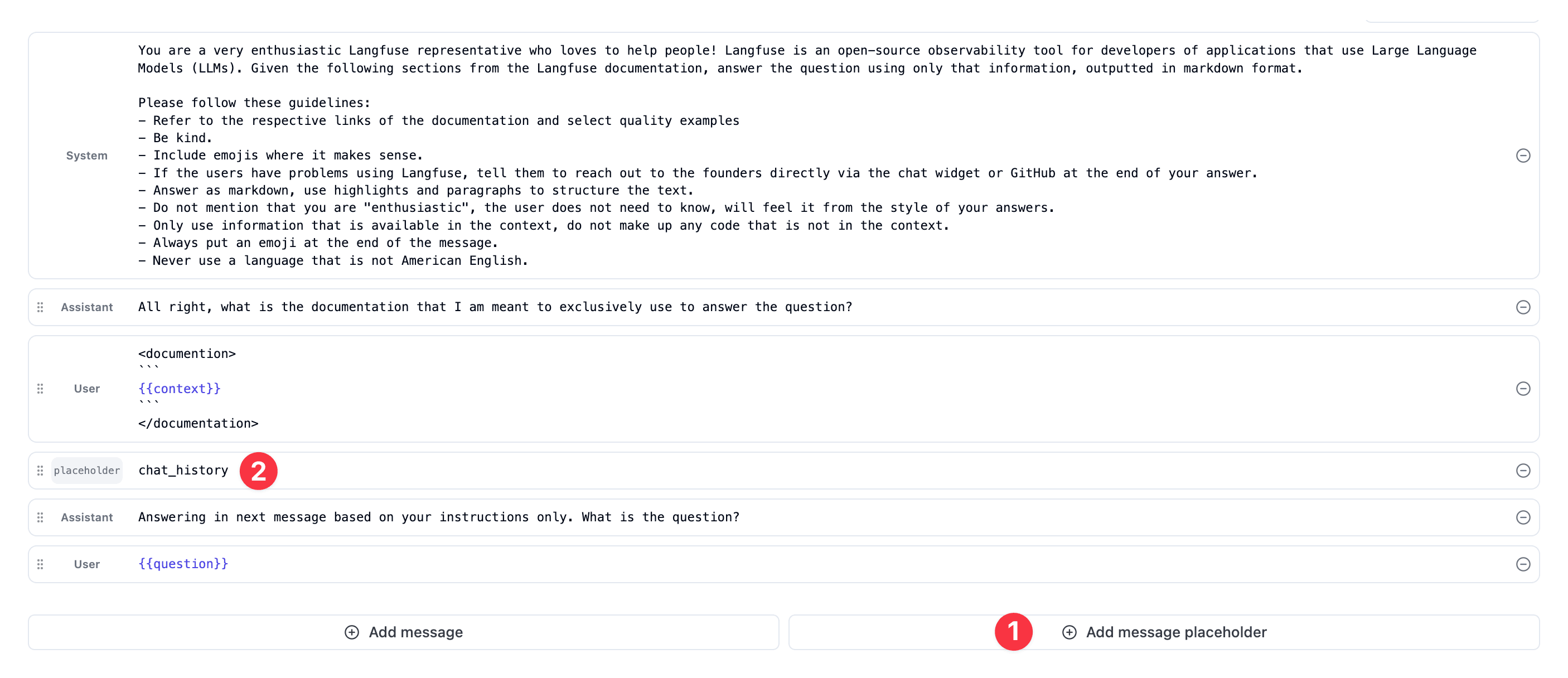
- Create a placeholder in any prompt by using the
Add message placeholderbutton. - Select a
namefor the placeholder that will be used to reference it in your application.
from langfuse import get_client

langfuse = get_client()

langfuse.create_prompt(
    name="movie-critic-chat",
    type="chat",
    prompt=[
      { "role": "system", "content": "You are an {{criticlevel}} movie critic" },
      { "type": "placeholder", "name": "chat_history" },
      { "role": "user", "content": "What should I watch next?" },
    ],
    labels=["production"],  # directly promote to production
)
import { LangfuseClient } from "@langfuse/client";
const langfuse = new LangfuseClient();
await langfuse.prompt.create({
name: "movie-critic-chat",
type: "chat",
prompt: [
{ role: "system", content: "You are an {{criticlevel}} movie critic" },
{ type: "placeholder", name: "chat_history" },
{ role: "user", content: "What should I watch next?" },
],
labels: ["production"], // directly promote to production
});Resolve placeholders at runtime
In the SDKs, use the .compile(variables, placeholders) method on a ChatPromptClient to set the values to be filled in for the placeholders.
The filled in messages should be of the ChatMessage format with a role and content property, but custom formats are also accepted as compile does not validate the format of the messages.
from langfuse import get_client

langfuse = get_client()

# Use prompt with placeholders in your application
prompt = langfuse.get_prompt("movie-critic-chat")

# Compile the variable and resolve the placeholder with a list of messages.
compiled_prompt = prompt.compile(criticlevel="expert", chat_history=[
  {"role": "user", "content": "I love Ron Fricke movies like Baraka"},
  {"role": "user", "content": "Also, the Korean movie Memories of a Murderer"}
])

# -> compiled_prompt = [
#   { "role": "system", "content": "You are an expert movie critic" },
#   { "role": "user", "content": "I love Ron Fricke movies like Baraka" },
#   { "role": "user", "content": "Also, the Korean movie Memories of a Murderer" },
#   { "role": "user", "content": "What should I watch next?" },
# ]
import { LangfuseClient } from "@langfuse/client";
const langfuse = new LangfuseClient();
const prompt = await langfuse.prompt.get("movie-critic-chat", {
type: "chat",
});
// Compile the variable and resolve the placeholder with a list of messages.
const compiledPrompt = prompt.compile(
// variables
{ criticlevel: "expert" },
// placeholders
{
chat_history: [
{ role: "user", content: "I love Ron Fricke movies like Baraka" },
{
role: "user",
content: "Also, the Korean movie Memories of a Murderer",
},
],
}
);
// -> compiledPrompt = [
// { role: "system", content: "You are an expert movie critic" },
// { role: "user", content: "I love Ron Fricke movies like Baraka" },
// { role: "user", content: "Also, the Korean movie Memories of a Murderer" },
// { role: "user", content: "What should I watch next?" },
// ]from langfuse import get_client
from langchain_core.prompts import ChatPromptTemplate
langfuse = get_client()
langfuse_prompt = langfuse.get_prompt("movie-critic-chat")
# Using langchain, you can obtain a MessagesPlaceholder object for unresolved placeholders
langchain_prompt = ChatPromptTemplate.from_template(langfuse_prompt.get_langchain_prompt())
# -> langchain_prompt = [
# SystemMessage(content="You are an expert movie critic"),
# MessagesPlaceholder(name="chat_history"),
# HumanMessage(content="What should I watch next?"),
# ]import { LangfuseClient } from "@langfuse/client";
import { ChatPromptTemplate } from "@langchain/core/prompts";
const langfuse = new LangfuseClient();
// Get current `production` version
const langfusePrompt = await langfuse.prompt.get("movie-critic-chat", {
type: "chat",
});
// Using langchain, you can obtain a ChatPromptTemplate with MessagesPlaceholder objects for unresolved placeholders
const langchainPrompt = ChatPromptTemplate.fromTemplate(
langfusePrompt.getLangchainPrompt()
);
// -> langchainPrompt = [
// SystemMessage(content="You are an expert movie critic"),
// MessagesPlaceholder(name="chat_history"),
// HumanMessage(content="What should I watch next?"),
// ]Not exactly what you need? Consider these similar features:
- Variables for inserting dynamic text into prompts
- Prompt references for reusing sub-prompts
Prompt Composability
Reference other prompts in your prompts using a simple tag format.
Config
The prompt config in Langfuse is an optional JSON object attached to each prompt that stores structured data such as model parameters (like model name, temperature), function/tool parameters, or JSON schemas.